5 Reasons Jero Tumbuk Rooms Do Not Need a Television
Home - Our Journal
Home - Our Journal
A television is one of those things you may not think about until it is not there.
You arrive at your room after a long day, look around, and realize there is no screen waiting to fill the evening.
At first, it may feel unusual.
But then you notice something else.
There is a garden outside.
There are natural sounds around you.
There is a book you brought but never had time to open.
There is someone sitting nearby you can actually talk to.
There is a cultural activity you have not tried yet.
Or perhaps there is simply nothing you need to do.
This is the idea behind the no TV retreat Bali experience at Jero Tumbuk.
The absence of a television is not intended to make the accommodation feel incomplete. It is an invitation to experience the environment differently.
Located in Selat, Karangasem, Jero Tumbuk is a living cultural retreat where accommodation is only one part of a wider experience connecting Balinese culture, nature, spirituality, education, and community.
The room gives you a place to rest.
The surroundings give you reasons to step outside.
Here are five reasons Jero Tumbuk rooms do not need a television.
A television gives you a view created somewhere else.
A natural setting gives you something happening right outside your door.
At Jero Tumbuk, the surrounding environment includes gardens, rice fields, trees, river areas, traditional spaces, and the wider landscape of Selat, Karangasem.
You can walk.
Sit outside.
Listen to the surroundings.
Watch the changing weather.
Notice the movement of people around the compound.
Spend time observing the landscape instead of watching something on a screen.
This is particularly relevant to the idea of a nature accommodation Bali experience.
Nature is not simply a view that exists in the background.
It can become part of how you spend your day.
A morning walk through the surrounding area, for example, can be more than exercise.
A rice field walk can introduce you to agriculture, local farmers, seasonal cultivation, and village life.
Suddenly, the landscape becomes something you understand rather than something you simply photograph.
You do not need a television to create an experience when there is already something worth paying attention to outside.
One of the reasons guests come to Jero Tumbuk is to experience more than accommodation.
The retreat creates opportunities to learn about Balinese culture through participation.
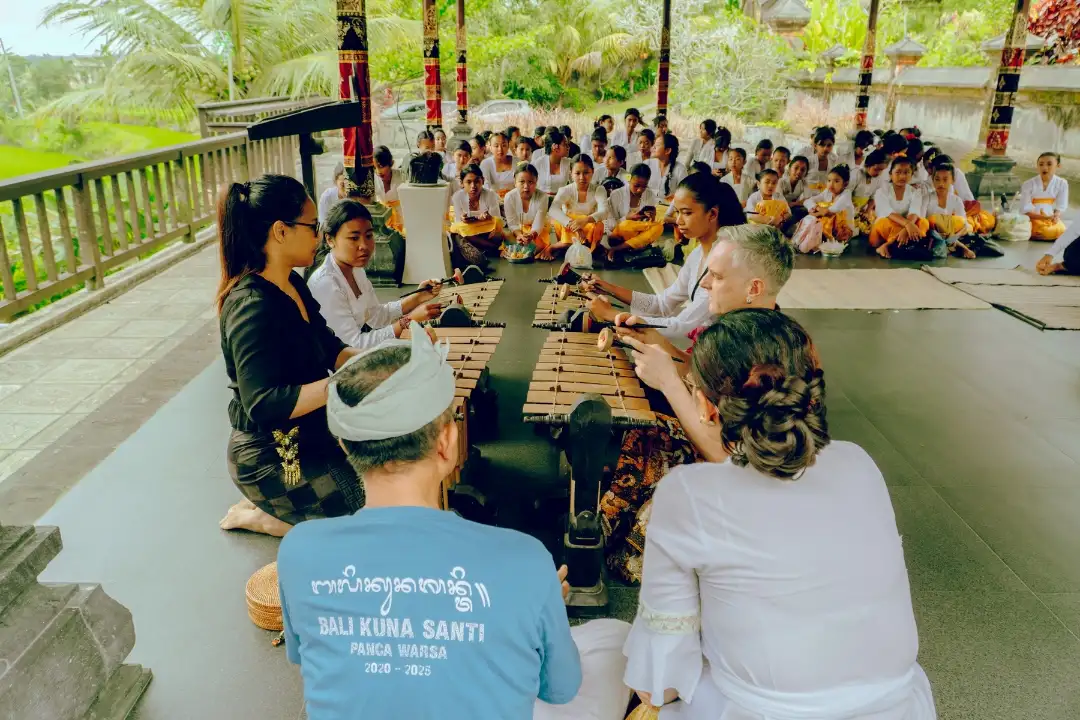
Depending on availability, guests may be able to join activities connected with traditional dance, Tabuh, Gender, Rindik, Mekidung, Balinese script, cooking, or other cultural experiences.
These activities give you something a television cannot.
Direct interaction.
You can ask a mentor why a technique is performed in a particular way.
You can learn how a traditional instrument works.
You can prepare ingredients during a cooking class.
You can discover the meaning behind a cultural practice.
You can make mistakes and try again.
That process matters.
Culture is not simply something to watch.
It is something people practice, teach, and pass between generations.
At Jero Tumbuk, local mentors and community members are part of that learning environment.
For guests, participating respectfully creates an opportunity to understand the people behind the traditions.
This is one of the foundations of a cultural experience Bali travelers can take home with them.
You may forget a television show you watched during your holiday.
You are more likely to remember the person who taught you something you had never tried before.
Not every meaningful holiday moment needs to be an activity.
Sometimes, it is a conversation.
Without a television automatically playing in the background, there is more room to talk.
You can have a longer conversation with your partner after dinner.
You can spend more time with your family.
You can talk with a friend about what you experienced during the day.
You can speak with a local mentor and ask questions about Balinese culture.
You can listen to someone's story.
This is particularly relevant to Jero Tumbuk because human connection is one of the central parts of its wider community approach.
The retreat is connected with local staff, cultural practitioners, teachers, farmers, children, and community programs.
Guests are not expected to become part of every program.
But they have opportunities to interact with people rather than experiencing Bali entirely through screens.
A conversation with a local person can reveal details about village life that you would never notice from a television program.
A cooking class can lead to a discussion about ingredients.
A cultural workshop can lead to questions about traditions.
A rice field walk can lead to a conversation about farming.
These moments can make a stay feel more personal.
There is another advantage to having no television in your room.
You do not have to replace it with anything.
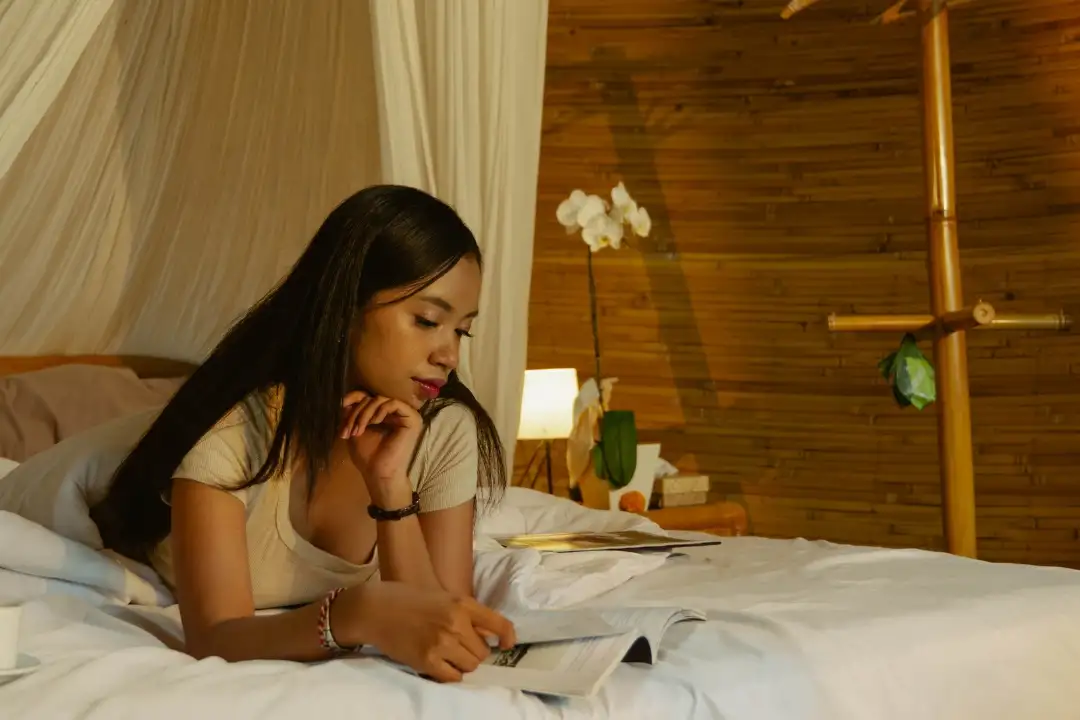
You can read.
Write in a journal.
Sit outside.
Listen to music from your own device if you want to.
Talk.
Take a nap.
Or do absolutely nothing.
This may sound simple, but doing nothing can be difficult when every empty moment is usually filled with content.
A mindful stay Bali experience does not need a strict schedule or a complicated wellness program.
Sometimes, mindfulness starts with noticing that you have a free hour and deciding not to fill it immediately.
At Jero Tumbuk, the quieter environment supports this kind of rhythm.
After a morning activity, you can return to your room and rest.
After a cultural workshop, you can spend time processing what you learned.
After exploring the rice fields, you can simply sit and enjoy the surroundings.
There is no requirement to be productive.
There is also no requirement to turn the quiet moment into a formal meditation session.
Rest is enough.
Reading is enough.
Doing nothing is enough.
A retreat should have room for pauses.
The idea behind a digital detox Bali experience is often misunderstood.
You do not necessarily need to surrender every device, disconnect completely, or spend your entire stay without internet.
That is not what a no-TV room automatically means.
You can still use your phone for communication, maps, travel information, photographs, bookings, or other practical needs.
The difference is that the television is not there as the default entertainment option.
That small change can make you more aware of how you spend your time.
Instead of turning on a screen automatically, you may ask yourself:
Do I want to take a walk?
Do I want to read?
Is there a cultural activity I would like to join?
Should I talk to someone?
Would I rather sit outside?
Or am I simply tired and want to sleep?
The choice becomes more conscious.
This fits naturally with slow travel Bali.
Slow travel does not mean doing nothing.
It means giving yourself enough time to experience fewer things more deeply.
A cooking class does not need to be followed by three more activities.
A rice field walk does not need to become part of a race to the next attraction.
A conversation does not need to have a time limit because the next television program is starting.
The absence of a screen can make the experience around you feel more present.
This expectation is important.
If you are specifically looking for a room with an in-room television, Jero Tumbuk's accommodation may not match that preference.
The no-TV concept is intentional.
However, it should not automatically be interpreted as a strict device-free retreat.
You can still use your personal devices according to your needs and the available connectivity.
The goal is not to tell guests how much technology they are allowed to use.
It is to create a room where television is not the centre of the experience.
Think of it as an invitation rather than a rule.
You can put your phone away for an hour.
Or you can use it when you need it.
You can spend the evening reading.
Or you can have a conversation.
You can join an activity.
Or you can rest.
The important thing is that you have alternatives.
If you are wondering what your evenings might actually look like, the answer does not need to be complicated.
Explore the surrounding environment and notice how different it feels from a busy Bali itinerary.
That book sitting in your luggage may finally get its chance.
Sit in the garden or another suitable outdoor space and simply observe the surroundings.
Use the quiet to have a proper conversation with your travel companion or someone you meet during your stay.
Depending on availability, participate in cooking, traditional arts, music, or other cultural learning experiences.
Write down what you experienced during the day, from a conversation with a mentor to something you noticed during a rice field walk.
Perhaps the most obvious alternative is also the easiest.
Go to bed.
A holiday does not need to be filled every minute.
The no-TV concept makes more sense when you understand what Jero Tumbuk is designed to be.
It is not a conventional accommodation experience where the room is expected to provide everything you need for entertainment.
Jero Tumbuk is a cultural retreat.
The accommodation is one part of a larger environment.
Outside the room, there are opportunities to discover nature, learn about Balinese culture, interact with local mentors, experience traditional food, explore agricultural landscapes, and understand community life.
That is why the absence of a television fits the wider philosophy.
The question is not:
“What does the room lack?”
The more useful question is:
“What does the environment give me a reason to experience?”
The answer can be a walk through the rice fields.
A traditional cooking class.
A cultural workshop.
A conversation.
A quiet garden.
A meditation session.
A community activity.
Or simply an evening without having something playing in the background.
At the end of a busy Bali day, it can be tempting to return to your room and disappear into a screen.
But a retreat offers another possibility.
You can slow down.
You can notice the sounds around you.
You can talk.
You can read.
You can reflect on what you experienced.
You can prepare for another day of learning.
This is what makes a peaceful retreat Bali experience more than simply having a quiet room.
The quiet creates space for the things around you to become more noticeable.
And at Jero Tumbuk, those things are connected.
Nature connects with agriculture.
Food connects with local knowledge.
Culture connects with mentors and younger generations.
Spirituality connects with sacred spaces and daily life.
Community connects people who live here with people who come to visit.
The television would simply be another distraction from that environment.
A no-TV room may sound like a small detail.
But sometimes, small changes affect how you experience an entire stay.
You may spend more time outdoors.
You may talk more.
You may read.
You may participate in a cultural activity.
You may walk through the rice fields.
You may simply notice how quiet an evening can be.
None of these experiences is guaranteed to transform you.
That is not the promise.
The invitation is much simpler.
Look up from the screen.
Look outside.
Notice the people.
Notice the landscape.
Notice the culture.
Give yourself permission to leave some time unfilled.
That is the thinking behind the no TV retreat Bali experience at Jero Tumbuk.
If you are looking for a quiet retreat Karangasem where accommodation is part of a wider cultural and natural experience, Jero Tumbuk gives you the space to spend your time differently.
Not because there is nothing to do.
But because there is plenty to experience beyond the screen.