5 Reasons Spiritual Experiences Need Respect More Than Hype
Home - Our Journal

Home - Our Journal
Spiritual experiences can be some of the most meaningful parts of a journey.
But they are also among the experiences that require the most care.
A sacred ritual is not simply another activity to add to a Bali itinerary.
It has a history.
It has meaning.
It has rules.
And most importantly, it belongs to a living culture and spiritual tradition.
This is especially important when travelers encounter spiritual tourism Bali experiences such as Melukat.
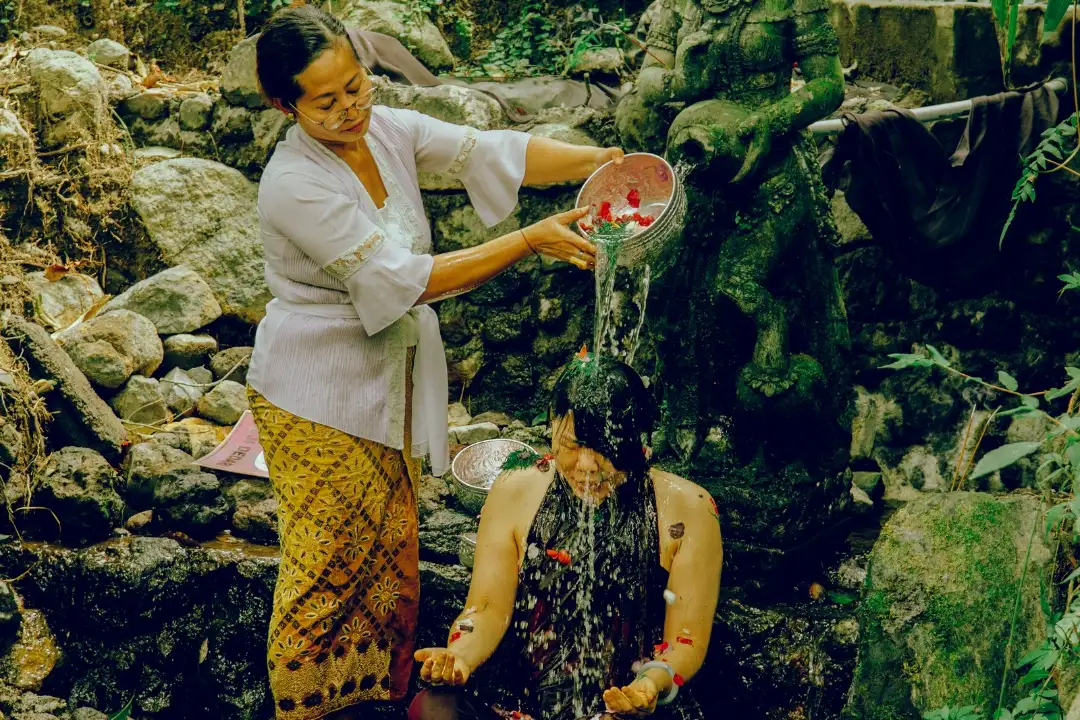
Melukat is a Balinese purification ritual involving sacred water, prayer, preparation, and spiritual guidance. For visitors, taking part can be an opportunity to learn about Balinese spirituality and culture.
But the experience should never be reduced to a photo opportunity, a social media trend, or a promise of instant transformation.
At Jero Tumbuk in Selat, Karangasem, spiritual activities are part of a wider cultural retreat experience connected with nature, community, education, and Balinese traditions.
The emphasis is on understanding and respectful participation.
Here are five reasons spiritual experiences need respect more than hype.
One of the easiest mistakes in cultural tourism is focusing only on what a visitor can experience.
A ritual looks beautiful.
The setting looks peaceful.
The water looks clear.
The traditional clothing looks interesting.
The photographs look impressive.
But these visible elements are only part of the story.
A spiritual ritual exists within a cultural context.
Melukat, for example, is not simply “taking a bath in holy water.”
It is a Balinese purification practice connected with prayer, sacred water, spiritual guidance, and cultural beliefs.
Understanding this context changes the way you approach the experience.
Instead of asking:
“What will I get from this?”
You can ask:
“What does this ritual mean?”
“Why is sacred water used?”
“What should I do during the process?”
“Why are certain preparations necessary?”
“Which parts of the ritual are sacred?”
These questions encourage learning rather than consumption.
This is an important principle for authentic spirituality Bali.
Authenticity does not come from making an experience look mysterious or dramatic.
It comes from allowing people to understand the meaning behind the practice.
For travelers, that means approaching spiritual activities with curiosity and humility.
You are being introduced to something that has significance beyond your holiday.
That deserves attention.
A sacred experience should not be treated as something visitors can simply improvise.
Guidance matters.
A local spiritual guide or knowledgeable practitioner can explain how the activity should be approached, what preparations are needed, and how guests should behave during the process.
This is particularly important for visitors who are unfamiliar with Balinese spiritual customs.
You may not know which areas are sacred.
You may not understand the order of a ritual.
You may not know when to pray, where to stand, or what you should avoid touching.
There is nothing wrong with not knowing.
The respectful response is to ask.
Follow instructions.
Listen carefully.
Do not assume that practices from another culture can be adapted according to your own expectations.
This is especially important for respectful Melukat.
The goal is not for guests to perform the ritual perfectly.
The goal is to participate appropriately under local guidance.
That creates a more genuine learning experience.
At Jero Tumbuk, spiritual activities form part of the wider cultural environment rather than existing as isolated entertainment.
Guests can learn through guidance and observation while respecting the people and traditions involved.
Wellness and spirituality have become increasingly popular in travel.
That popularity can create a temptation to make big promises.
A ritual is described as something that will remove all stress.
A spiritual activity is presented as guaranteed healing.
A ceremony is marketed as a way to completely transform someone's life in one session.
This is where communication needs to become more responsible.
Spiritual experiences should not be sold as guaranteed medical, psychological, or emotional treatments.
Melukat should not be presented as an instant cure.
Meditation should not be presented as a guaranteed solution to a person's problems.
Yoga should not be marketed as a replacement for professional medical care.
These activities can provide opportunities for reflection, cultural understanding, prayer, awareness, or personal meaning.
But individual experiences are different.
There is no need to exaggerate.
In fact, removing exaggerated claims can make the experience more meaningful.
A traveler does not need to be promised a life-changing result before participating.
They can simply be invited to learn.
This approach is particularly important in responsible travel.
Responsible communication respects both the traveler and the culture being presented.
It does not use spiritual beliefs as a marketing shortcut.

When entering a sacred environment, what you wear and how you behave matter.
Visitors may come from cultures where clothing rules around spiritual spaces are different.
That is perfectly normal.
The important thing is being willing to adapt.
For spiritual activities at Jero Tumbuk, guests should follow local instructions about appropriate clothing and preparation.
Choose clothing that is respectful and suitable for the setting.
Do not treat sacred spaces like ordinary tourist attractions.
Keep your voice appropriate.
Follow the guidance of the people conducting or facilitating the activity.
Do not touch offerings, sacred objects, or other items unless you are specifically invited to do so.
And remember that not every area within a traditional compound is necessarily intended for visitors.
These are simple examples of Balinese ritual etiquette.
The objective is not to make travelers nervous about making mistakes.
It is to encourage awareness.
You do not need to know every Balinese custom before arriving.
You do need to be willing to listen.
If someone explains that you should dress differently, follow the instruction.
If an area is restricted, respect the boundary.
If you are unsure, ask.
Respect is often more important than knowing every rule in advance.
Modern travel makes documentation almost automatic.
See something interesting.
Take a photo.
Record a video.
Post it.
Move on.
But spiritual experiences require a different approach.
Not every part of a ritual should be photographed.
Not every person wants to appear in a travel video.
Not every sacred object is appropriate for social media.
Before documenting a spiritual activity, ask.
This applies to both photography and video.
If a guide says that cameras or phones should be put away, follow the instruction.
If someone is praying, avoid interrupting them for a photograph.
If a sacred space is not open for photography, respect the restriction.
And do not assume that because other visitors are taking pictures, you automatically have permission to do the same.
This is one of the simplest forms of cultural respect Indonesia travelers can practice.
Sometimes, the most respectful photograph is the one you decide not to take.
The experience does not become less meaningful because it was not documented.
In fact, putting the phone away can help you pay closer attention to what is actually happening.

For international visitors, Melukat can be unfamiliar.
A simple explanation helps.
Melukat is a Balinese purification ritual associated with sacred water and prayer.
The process can involve preparation, appropriate clothing, guidance, prayer, and participation according to local customs.
The details can vary depending on the context and the people conducting the ritual.
That is why visitors should not rely only on generic descriptions found online.
Ask the local guide about the specific process.
Find out what you should bring.
Understand how you should dress.
Listen to instructions before the ritual begins.
Follow guidance throughout the process.
And give yourself permission to observe if you are unsure about participating in a particular part.
The objective is not to turn a sacred ritual into a performance.
It is to understand it respectfully.
At Jero Tumbuk, spiritual experiences do not exist separately from everything else.
They are connected with the wider philosophy of the retreat.
Nature.
Culture.
Community.
Education.
Spirituality.
This reflects the principles of Tri Hita Karana.
Parahyangan describes the relationship between people and the divine.
Palemahan describes the relationship between people and nature.
Pawongan describes the relationship between people.
A spiritual activity can therefore be understood within a much larger context.
The sacred water used in a ritual has a relationship with nature.
The people guiding the ritual represent cultural knowledge passed between generations.
The guest's behaviour affects their relationship with the people and community around them.
Nothing exists completely on its own.
This is why a cultural retreat Bali experience can offer a deeper perspective than treating spirituality as a standalone wellness activity.
The goal is to understand relationships.
Travel marketing often rewards big language.
Transformative.
Life-changing.
Powerful.
Ultimate.
But spiritual experiences do not need dramatic descriptions to be meaningful.
A quiet prayer can matter.
A few minutes beside sacred water can be meaningful.
Listening to a local guide can teach you something.
Learning why a ritual is performed can change the way you understand Balinese culture.
Putting your phone away can help you pay attention.
Following a dress code can demonstrate respect.
Sometimes, the experience becomes more meaningful precisely because it is not being exaggerated.
There is no need to promise what someone will feel afterward.
Let the ritual speak for itself.
Let the cultural context provide the meaning.
Let the participant decide what the experience means to them.
If you are considering a spiritual activity at Jero Tumbuk, a few simple principles can help.
Learn before participating.
Ask what the activity means and what preparation is required.
Follow local guidance.
The people facilitating the experience understand the cultural and spiritual context.
Dress appropriately.
Respect clothing requirements around sacred spaces.
Stay calm and attentive.
Do not treat the ritual as a performance or rush through the process.
Ask before taking photographs.
Respect both sacred spaces and the privacy of other participants.
Do not touch sacred objects without permission.
Observe first and follow instructions.
Avoid exaggerated expectations.
Do not approach a ritual expecting guaranteed healing or a specific personal result.
Prioritize meaning over content.
You do not need a photograph or video of every moment for the experience to matter.
These principles are simple.
But they can make a significant difference.
There is a difference between experiencing spirituality and consuming spirituality.
Consumption asks:
“What can I photograph?”
“What will I get from this?”
“How impressive will it look?”
Learning asks:
“What does this mean?”
“Who practices it?”
“Why is it important?”
“How should I behave?”
That difference can change the entire experience.
At Jero Tumbuk, spiritual activities such as Melukat, meditation, and yoga form part of a broader cultural retreat grounded in Balinese life.
Guests are invited to experience them with awareness rather than hype.
The focus is not on promising instant healing.
It is not on creating dramatic spiritual stories.
It is on understanding.
Participating respectfully.
Listening to local guidance.
And recognizing that spirituality is part of a living culture.
You do not need to arrive as an expert in Balinese spirituality.
You simply need to arrive willing to learn.
Ask questions.
Listen to your guide.
Dress appropriately.
Respect sacred spaces.
Put your camera away when asked.
Do not turn a ritual into entertainment.
And allow the experience to be what it is without demanding a dramatic result.
This is the foundation of spiritual tourism Bali that respects the people and traditions involved.
At Jero Tumbuk, a spiritual experience can become part of a larger journey through culture, nature, community, and reflection.
The most important thing you take away may not be a photograph.
It may be a better understanding of why the ritual matters.
And sometimes, that understanding is more valuable than anything you can post online.