5 Ways Tri Hita Karana Shapes the Jero Tumbuk Experience
Home - Our Journal
Home - Our Journal
A retreat can offer beautiful surroundings, comfortable accommodation, and interesting activities.
But what makes an experience meaningful beyond those elements?
At Jero Tumbuk in Selat, Karangasem, the answer can be found in a Balinese philosophy that connects people with the divine, nature, and one another.
This philosophy is called Tri Hita Karana.
For travelers unfamiliar with Bali, the term may sound complex. But the principle becomes easier to understand when you see how it appears in everyday life.
Tri Hita Karana describes three relationships:
Parahyangan — harmony between people and the divine.
Palemahan — harmony between people and nature.
Pawongan — harmony between people.
At Jero Tumbuk, these three relationships are reflected through spiritual practices, natural surroundings, cultural learning, education, local employment, community programs, and the way guests are invited to participate.
This is the foundation of the Jero Tumbuk philosophy.
Rather than presenting Tri Hita Karana as something visitors only learn about, Jero Tumbuk creates opportunities to encounter the principle through real places, people, and activities.
Here are five ways the philosophy shapes the Jero Tumbuk experience.
The first part of Tri Hita Karana is Parahyangan Bali, the relationship between people and the divine.
In Bali, spirituality is not necessarily separated from everyday life.
It can be found in prayer, offerings, sacred spaces, ceremonies, and practices that connect people with God and their ancestors.
At Jero Tumbuk, guests can encounter this dimension through spaces and activities connected to Balinese spirituality.
The Merajan, for example, represents an important sacred space within the cultural environment. Canang sari, prayer, and other forms of spiritual practice can also help visitors understand how spirituality remains part of daily Balinese life.
Guests may also have the opportunity to experience Melukat.
Melukat is a Balinese purification ritual involving sacred water, prayer, preparation, and spiritual guidance. It should be approached as a sacred cultural and spiritual practice rather than a tourist performance or guaranteed healing treatment.
For visitors, participation begins with respect.
Follow local instructions.
Wear appropriate clothing.
Stay calm during the process.
Respect sacred areas.
Ask before taking photographs.
These simple actions allow guests to learn without turning the ritual into entertainment.
Yoga, meditation, and other reflective activities can also create quieter opportunities for awareness.
The purpose is not to promise instant transformation.
Instead, these experiences give guests time to pause, reflect, and understand another dimension of Balinese life.
Through Parahyangan, the retreat becomes more than a place to relax.
It becomes a place where visitors can observe how spirituality forms part of the relationship between people, place, and daily life.
The second relationship is Palemahan Bali, the harmony between people and nature.
This principle becomes immediately visible around Jero Tumbuk.
Rice fields.
Gardens.
Trees.
River areas.
Bamboo.
Natural surroundings.
The wider landscape of Selat and Karangasem.
These are not simply visual elements surrounding the accommodation.
They are part of an environment that supports daily life.
A rice field, for example, is more than a beautiful Bali landscape. It is connected to farmers, food production, water, seasonal cycles, and local livelihoods.
A rice field tour can help guests understand this relationship directly.
Instead of simply photographing the fields, visitors can learn how rice is cultivated, how farming changes with the seasons, and how much work goes into producing food.
This creates a different understanding of nature.
Nature is not simply something to look at.
It is something people depend on and have a responsibility to respect.
The same principle can be seen in the use of natural materials such as bamboo and wood within the Jero Tumbuk environment.
The relationship between buildings and their surroundings creates another opportunity to understand how local materials and natural landscapes are part of Balinese life.
Guests can participate in this relationship through simple actions:
Stay on appropriate paths.
Avoid damaging plants or crops.
Do not leave waste behind.
Respect local farming areas.
Use natural resources thoughtfully.
Listen to local guidance when exploring outdoor spaces.
This is one reason the Balinese life philosophy of Tri Hita Karana remains relevant to a retreat experience.
It encourages people to think not only about what nature provides, but also about how people interact with it.
The third relationship is Pawongan Bali, harmony between people.
This may be the most visible part of the Jero Tumbuk experience because so much of the retreat is built around human connection.
Local staff.
Teachers.
Cultural mentors.
Farmers.
Artisans.
Children.
Community members.
Guests.
Each person contributes to a wider ecosystem.
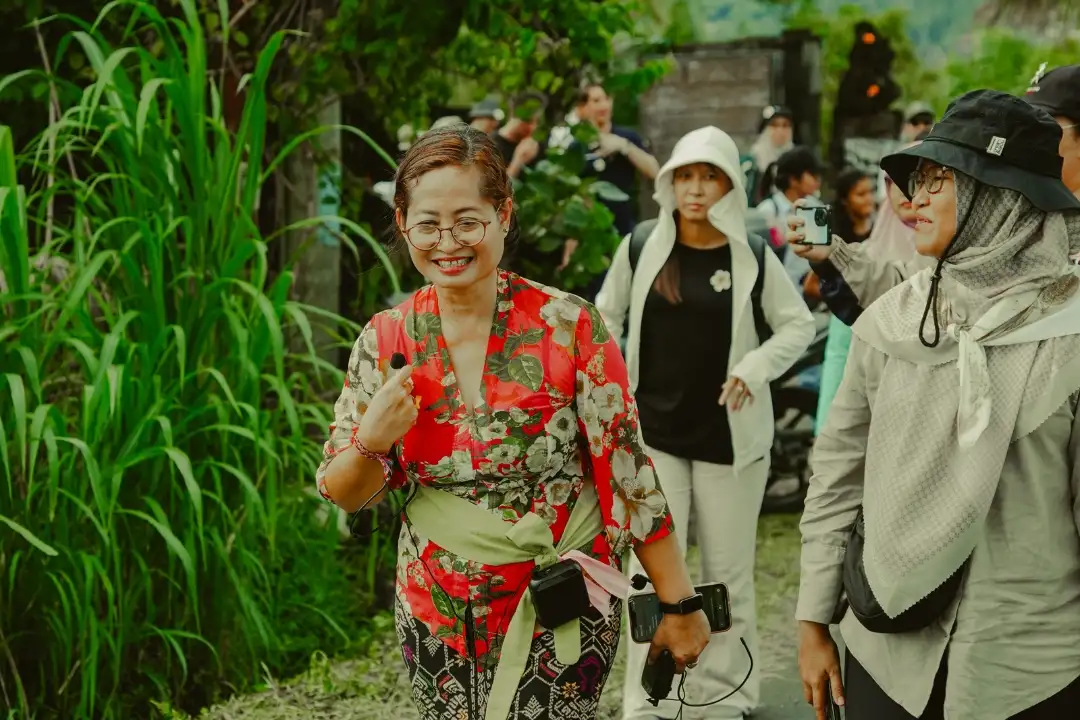
Jero Tumbuk creates opportunities for guests to interact with local people through cultural learning and community-connected activities.
A guest might learn Balinese dance from a local mentor.
They may try traditional music such as Tabuh, Gender, or Rindik.
They may learn Balinese script or Mekidung.
They may join a cooking class and learn about local ingredients.
These experiences create direct relationships between visitors and people who carry local knowledge.
The point is not simply to provide entertainment.
It is to create opportunities for learning.
A mentor can explain the meaning behind a cultural practice.
A teacher can correct a technique.
A local cook can explain how ingredients are prepared.
A farmer can describe the relationship between agriculture and the surrounding landscape.
This human connection is central to the cultural retreat concept at Jero Tumbuk.
Culture becomes something guests learn through people rather than something they simply observe from a distance.
Tri Hita Karana is not only about what guests experience.
It also shapes how the wider community can benefit from the ecosystem.
Jero Tumbuk's community approach includes education programs and opportunities connected to local people.
Children can participate in learning activities such as English classes, academic support, and cultural education.
These programs create space for younger generations to develop communication skills, confidence, and knowledge while remaining connected to their community.
Cultural learning can also support continuity.
Children who practice traditional dance, music, Mekidung, or Balinese script are not simply learning activities for visitors.
They are developing their own relationship with cultural knowledge.
Teachers and mentors play an important role in this process.
They provide guidance, correct techniques, explain meaning, and help students continue practicing.
This is Pawongan in action.
The relationship between teacher and student becomes part of a wider community effort.
Local employment is another practical expression of the same principle.
Staff, farmers, local suppliers, craftspeople, cultural practitioners, teachers, and activity providers can all form part of the wider ecosystem surrounding a retreat.
This does not mean every product or service should automatically be described as locally sourced or community-owned. The important point is that Jero Tumbuk recognizes the value of involving local people and creating opportunities within the surrounding community.
This makes the idea of a sustainable retreat Bali experience more meaningful when understood through relationships rather than simply environmental claims.
Sustainability is not only about nature.
It can also involve the continuity of skills, education, local participation, and community relationships.
Perhaps the most important way Tri Hita Karana shapes Jero Tumbuk is through the role of the guest.
You can stay in a beautiful place without becoming connected to it.
Participation changes that.
Instead of simply looking at a rice field, you can learn about farming.
Instead of only watching a cultural performance, you can learn from a mentor.
Instead of ordering Balinese food, you can join a cooking class.
Instead of photographing a spiritual ritual, you can learn the etiquette and meaning behind it.
Instead of moving through the landscape quickly, you can spend time observing it.
Participation does not mean guests need to join every available activity.
It means choosing experiences with curiosity and respect.
This is where the three relationships come together.
A cooking class can connect Palemahan through local ingredients and agriculture with Pawongan through the people who prepare and teach the food.
A cultural class can connect Pawongan through mentors and students with the preservation of cultural knowledge.
A Melukat experience can connect Parahyangan with a sacred natural environment and the people who guide the ritual.
A rice field tour can connect nature, agriculture, local livelihoods, and community life.
The boundaries between the three relationships are not always separate.
They overlap.
That is part of what makes Tri Hita Karana a useful way to understand Balinese life.
It can be easy to turn a cultural philosophy into a sentence on a website.
But the meaning becomes stronger when people can see how it is practiced.
At Jero Tumbuk, Parahyangan can be encountered through spiritual spaces, Melukat, prayer, meditation, and respectful cultural practices.
Palemahan can be experienced through rice fields, gardens, rivers, natural materials, agriculture, and the surrounding landscape.
Pawongan can be experienced through local staff, cultural mentors, teachers, children, farmers, community programs, and guest interactions.
Together, these relationships create the foundation of the retreat.
This is why Jero Tumbuk is not simply accommodation with cultural activities added to the itinerary.
The cultural, natural, spiritual, and community elements are connected.
Understanding Tri Hita Karana Bali does not require memorizing a complicated philosophy.
Start with three simple questions:
How do I relate to what is sacred?
That is Parahyangan.
How do I relate to nature?
That is Palemahan.
How do I relate to other people?
That is Pawongan.
These questions can change the way you travel.
You may become more thoughtful about entering sacred spaces.
You may pay closer attention to the people who grow and prepare your food.
You may become more respectful when walking through agricultural areas.
You may listen more carefully when learning from a local mentor.
You may begin to see a community not as a tourist attraction, but as a living environment.
At Jero Tumbuk, these ideas come together through a retreat experience grounded in culture, nature, spirituality, education, and community.
The philosophy is not something guests need to simply read about.
They can encounter it through the people they meet, the places they enter, the activities they join, and the way they choose to participate.
That is the deeper meaning behind the Jero Tumbuk experience.
Not simply staying in Bali.
But learning how people, nature, culture, and spirituality can exist in relationship with one another.