7 Lessons About Balance You Can Learn from Tri Hita Karana


What does it really mean to live a balanced life?
For many people, balance means finding enough time for work, rest, exercise, relationships, and personal interests. It can mean putting the phone away for an evening or taking a break from a busy schedule.
In Bali, the idea of balance can be understood through a much wider perspective.
Tri Hita Karana is a Balinese philosophy centered on harmony between three important relationships: people and the divine, people and nature, and people with one another.
These three relationships are known as Parahyangan, Palemahan, and Pawongan.
The philosophy is not simply something to read about while traveling in Bali. It can offer practical lessons about how we interact with the world around us.
At Jero Tumbuk in Selat, Karangasem, these principles are part of the foundation behind a living cultural retreat that connects spirituality, nature, culture, education, and community life.
For international travelers, understanding the Tri Hita Karana meaning can also provide a different way to think about everyday life.
Here are seven lessons about balance that you can take with you, even after leaving Bali.
1. Practice Gratitude for What You Already Have
Modern life can make it easy to focus on what comes next.
The next destination.
The next purchase.
The next promotion.
The next achievement.
Tri Hita Karana offers a different starting point: recognizing the relationships and resources that already support your life.
Gratitude can be expressed through simple actions. Appreciating food before eating it. Respecting the people who prepared it. Taking care of the environment that provides natural resources. Making time for spiritual reflection.
Within Parahyangan, gratitude is connected to the relationship between people and the divine.
In Balinese life, this relationship can be visible through practices such as making canang sari, prayer, visiting sacred spaces, and participating in religious rituals.
For someone unfamiliar with Balinese Hindu traditions, the lesson does not have to mean copying these practices.
Instead, you can translate the principle into your own life.
Before starting your day, take a moment to recognize what makes it possible. Your health, your family, the people you work with, the food you have access to, or simply the opportunity to rest.
Gratitude does not require a perfect life.
It requires attention.
That small shift can change how you approach the rest of your day.
2. Treat Nature as a Relationship, Not a Resource
Many travelers experience Bali through its natural scenery.
They photograph rice fields, visit waterfalls, walk beside rivers, and admire mountain landscapes.
But nature is more than something beautiful to look at.
Palemahan, one of the three relationships in Tri Hita Karana, focuses on harmony between people and nature.
This idea encourages a different question:
How do our actions affect the environment that supports us?
At Jero Tumbuk, this relationship can be seen through the surrounding rice fields, river areas, gardens, trees, local food, and the use of natural materials such as bamboo and wood.
A rice field is not simply a landscape. It is connected to farmers, food production, livelihoods, water, and community life.
A river is not simply a scenic location. It can have ecological, agricultural, cultural, and spiritual importance.
You can apply the same thinking anywhere.
Buy what you actually need.
Reduce unnecessary waste.
Respect natural spaces.
Avoid damaging plants or wildlife for photographs.
Use water thoughtfully.
Choose experiences that give you a better understanding of the environment rather than treating nature as a backdrop.
A balance with nature does not require living completely off the grid.
It can begin with becoming more conscious of the resources you use every day.
3. Make Time for Spiritual Awareness
Spirituality does not have to mean following a particular religion.
For some people, it may mean prayer. For others, meditation, quiet reflection, gratitude, or simply creating time to think about what matters.
Parahyangan, the spiritual dimension of Tri Hita Karana, emphasizes the relationship between human beings and the divine.
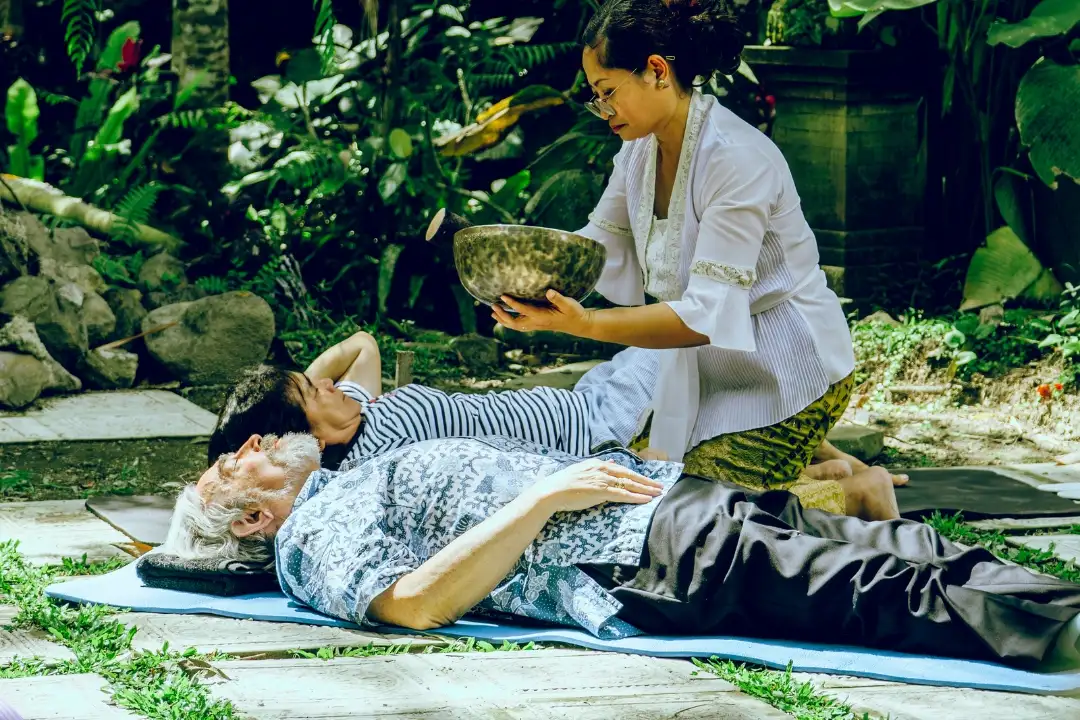
At Jero Tumbuk, spirituality can be encountered through practices and spaces such as Melukat, canang sari, Merajan, meditation, yoga, and other reflective activities.
These experiences should not be reduced to wellness trends.
Melukat, for example, is a Balinese purification ritual with religious and cultural meaning. It should be approached through local guidance and respect rather than marketed as instant healing.
The broader lesson is about awareness.
Modern life is full of noise. Notifications, messages, deadlines, entertainment, and constant information can make silence feel unfamiliar.
Creating even a few minutes of quiet each day can help you notice what is happening internally.
You might meditate for ten minutes.
You might pray.
You might sit without your phone.
You might write in a journal.
The specific practice matters less than creating intentional space for awareness.
This is one practical way to bring Balinese spirituality into a broader conversation about mindful living without removing it from its cultural context.
4. Invest in Relationships, Not Only Productivity
A productive day can look impressive on paper.
You completed your tasks. Answered your messages. Attended every meeting. Finished your work.
But productivity does not automatically create a balanced life.
Pawongan, the third relationship within Tri Hita Karana, focuses on harmony between people.
It reminds us that relationships are not something to fit into the remaining space after everything else is finished.
They are part of a healthy life.
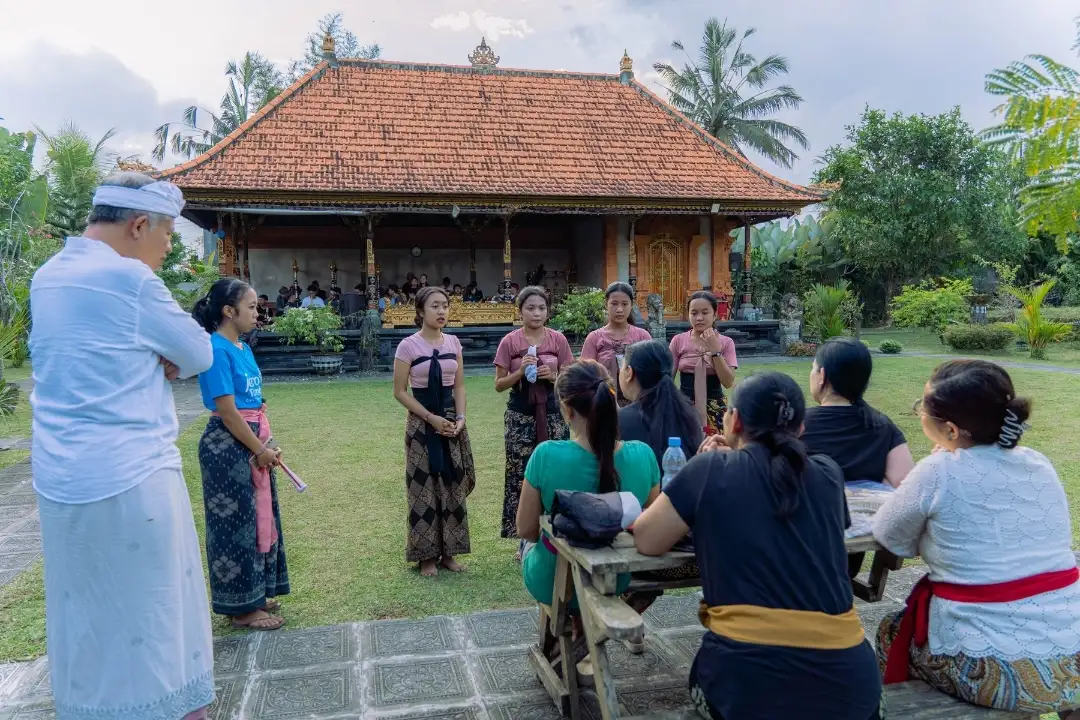
At Jero Tumbuk, Pawongan can be seen through cultural mentors teaching children, community learning programs, local staff, farmers, teachers, and people working together to maintain cultural and social activities.
Traditional music offers another example.
In gamelan, each participant has a role. The music works because people listen to one another, follow the rhythm, and understand how their contribution fits within the group.
Everyday life works in a similar way.
Listen when someone is speaking.
Make time for family.
Check in with a friend without needing a reason.
Thank people for their work.
Learn from someone whose experience is different from yours.
Strong relationships require attention, not only good intentions.
A balanced life is not built entirely through individual achievement.
It is also built through the people we choose to care for and the communities we choose to participate in.
5. Take Responsibility for the Community Around You
Community responsibility is closely connected to Pawongan.
It asks us to look beyond our immediate needs and consider how our choices affect other people.
At Jero Tumbuk, this principle is reflected through community education, cultural learning, local employment, cultural mentors, and social initiatives.
Programs may include English classes, academic support, cultural learning, workshops, and other community activities.
The important lesson is not that every person needs to become a volunteer.
It is about recognizing that our actions exist within a wider network.
As a traveler, you can think about where your money goes.
Can you support local businesses?
Can you learn from local practitioners?
Can you purchase appropriate local products?
Can you choose community-connected experiences?
Can you behave respectfully in villages and sacred spaces?
You do not need to assume that a community needs to be “saved” by visitors.
Local people already have their own knowledge, leadership, businesses, traditions, and systems.
Responsible participation means listening first.
It means recognizing local expertise rather than assuming that an outsider automatically knows what is best.
This is an important part of community values Bali and responsible travel more broadly.
6. Consume With More Awareness
Balance also applies to consumption.
Travel can encourage people to consume constantly.
Another meal.
Another souvenir.
Another activity.
Another photograph.
Another attraction.
Another booking.
The result can be a holiday that feels surprisingly exhausting despite being designed for relaxation.
Tri Hita Karana encourages a wider awareness of relationships, including our relationship with nature and other people.
That perspective can influence how we consume.
Before buying something, ask whether you genuinely need it.
When choosing food, consider where the ingredients come from.
When visiting a natural area, consider the impact of your presence.
When booking an experience, consider who provides it and whether the activity respects local culture.
Conscious consumption does not mean refusing everything.
It means making decisions with greater awareness.
At Jero Tumbuk, this idea can be connected to local farmers, food suppliers, craftspeople, staff, and cultural practitioners.
A cooking class can help guests understand the people and ingredients behind Balinese food. A rice-field tour can introduce the work behind the landscape.
Learning changes consumption into appreciation.
Instead of asking only, “What can I get from this experience?”
you begin asking, “What relationships make this experience possible?”
7. Balance Your Daily Life Instead of Waiting for a Holiday
Perhaps the most useful lesson from Tri Hita Karana is that balance should not exist only during a retreat.
You do not need to travel to Bali every time you feel overwhelmed.
You can bring small elements of a more balanced rhythm into ordinary life.
Start your morning without immediately checking your phone.
Eat one meal without a screen.
Spend time outside.
Call someone you care about.
Take a few minutes to meditate or pray.
Buy less and choose more carefully.
Learn something from another person.
Make time for activities that have meaning beyond productivity.
These actions may appear small, but together they change how you relate to your day.
This is where mindful living Bali can become more than a travel concept.
The point is not to recreate someone else’s lifestyle.
It is to become more conscious of your own relationships—with yourself, other people, nature, and whatever spiritual values guide you.
Understanding Tri Hita Karana as a Whole
The three relationships of Tri Hita Karana are strongest when considered together.
Parahyangan connects people with the divine.
It can be expressed through prayer, sacred spaces, offerings, rituals, and spiritual awareness.
Palemahan connects people with nature.
It can be expressed through caring for the environment, respecting natural resources, understanding agriculture, and making conscious choices about consumption.
Pawongan connects people with one another.
It can be expressed through family, friendship, education, community participation, mentorship, and mutual respect.
None of these relationships exists completely on its own.
A meal can involve nature, people, and gratitude.
A cultural class can involve teachers, students, heritage, and community.
A rice field can connect farmers, food, nature, and local livelihoods.
A spiritual ritual can connect people, sacred spaces, water, tradition, and community.
This interconnectedness is what makes the Balinese life philosophy relevant beyond a simple definition.
How Jero Tumbuk Brings These Principles Into Everyday Experience
Jero Tumbuk is a living cultural retreat in Selat, Karangasem, where these relationships are reflected through the wider environment.
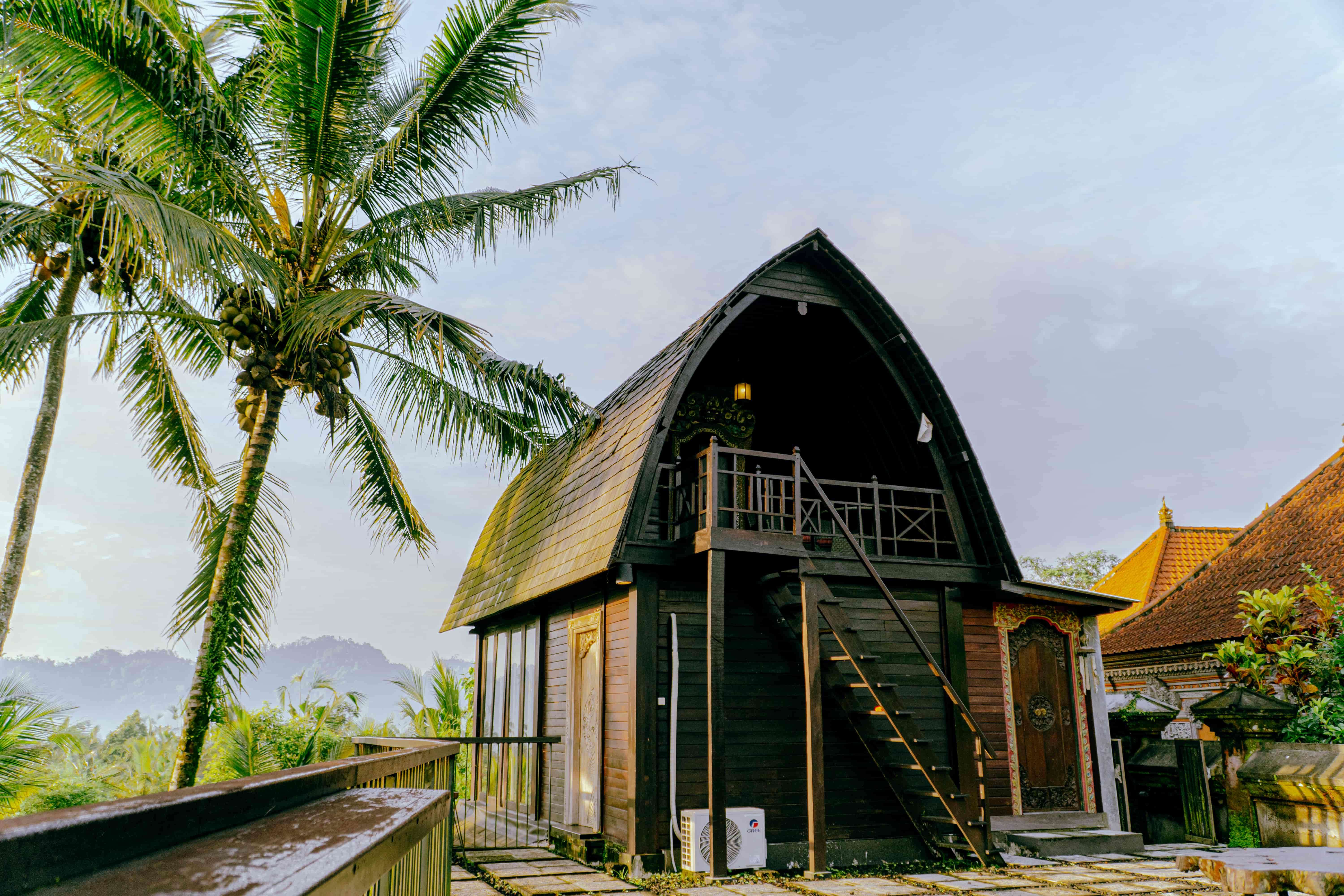
Guests can stay in accommodation connected to nature while having opportunities to learn about Balinese culture, participate in cultural programs, explore agriculture, practice reflection, and understand community initiatives.
The experience can include activities such as cultural learning, cooking, rice-field tours, yoga, meditation, and Melukat, depending on availability and appropriate arrangements.
But no activity should be treated as a shortcut to understanding Bali.
The value comes from the relationships behind the experience.
The mentor teaching the class.
The farmer working in the rice field.
The people preparing local food.
The children learning traditional arts.
The person guiding a spiritual practice.
The community members maintaining cultural programs.
This is why Jero Tumbuk is more than accommodation.
It provides a setting where travelers can encounter Tri Hita Karana through real people, places, practices, and conversations.
A Simple Way to Apply the Philosophy
You do not need to completely change your lifestyle.
Try three questions at the beginning or end of each day:
How am I treating what is sacred or meaningful to me?
This relates to Parahyangan.
How am I treating the natural world around me?
This relates to Palemahan.
How am I treating the people around me?
This relates to Pawongan.
The answers may reveal where your life already feels balanced and where it needs more attention.
Maybe you spend too much time working and too little time with people you care about.
Maybe you consume more than you need.
Maybe you rarely spend time outside.
Maybe you have forgotten to create quiet moments for reflection.
The philosophy does not need to provide a complicated solution.
It can simply help you notice.
Balance Is About Relationships
The Tri Hita Karana meaning becomes easier to understand when you stop thinking of balance as a personal achievement.
Balance is not only about feeling calm.
It is about relationships.
Your relationship with the divine.
Your relationship with nature.
Your relationship with other people.
These relationships influence one another.
When we respect nature, we support communities that depend on it. When communities remain connected, cultural knowledge can continue. When spiritual awareness creates gratitude, we may become more conscious of how we treat people and the environment.
This is the deeper lesson behind Tri Hita Karana.
At Jero Tumbuk, guests can experience this philosophy through a living environment where culture, nature, spirituality, education, and community are connected.
You do not have to adopt every practice you encounter.
Instead, take the principle with you.
Slow down enough to notice.
Consume with awareness.
Respect the natural world.
Make time for people.
Create space for spiritual or personal reflection.
And remember that a balanced life is not something you achieve once.
It is something you continue to practice every day.