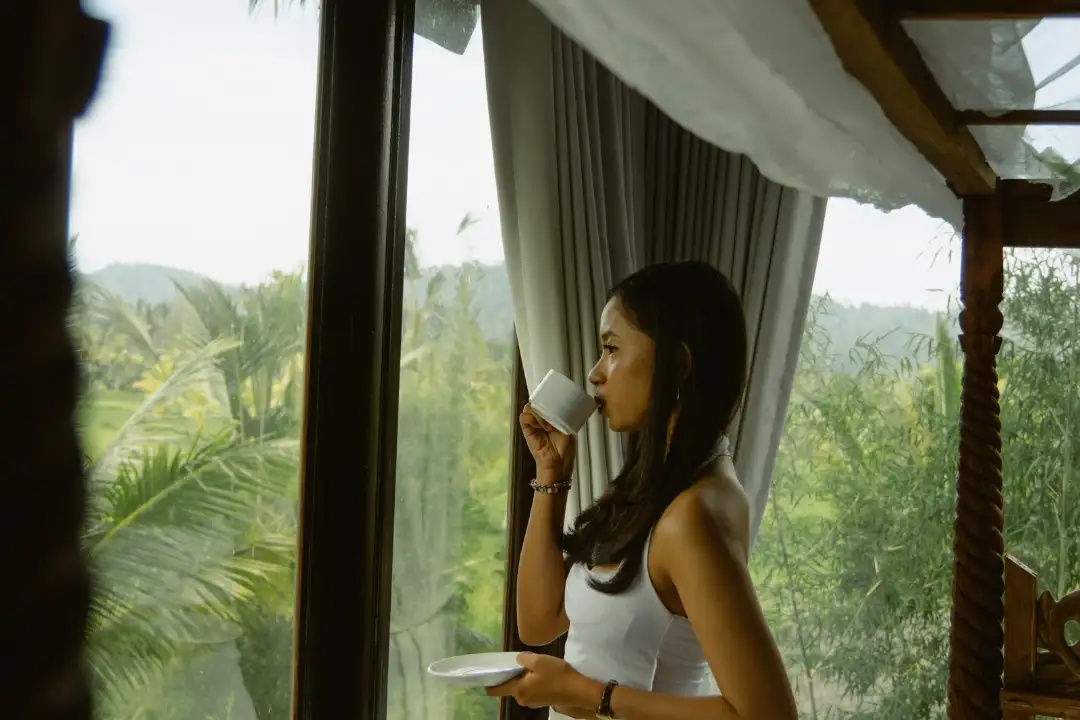
5 Reasons Slow Travel Can Help You Understand Bali Better
Home - Our Journal

Home - Our Journal
Bali is easy to experience quickly. There are temples to visit, beaches to photograph, waterfalls to discover, restaurants to try, and countless activities that can fill a travel itinerary from morning until night. With so many possibilities, it can be tempting to move from one destination to another without spending much time in any one place. But seeing more does not always mean understanding more.
A different approach is to slow down and give yourself enough time to notice the people, landscapes, traditions, and everyday routines that make a place what it is. Instead of trying to collect as many destinations as possible, you can choose fewer experiences and give yourself more time to participate in them.
This is the idea behind slow travel Bali. It is not about doing nothing or avoiding popular destinations completely. It is about changing the pace of your journey so that you have more opportunities to observe, learn, interact, and appreciate where you are.
For travelers looking for an authentic Bali experience, this can create a very different kind of holiday. At Jero Tumbuk in Selat, Karangasem, the experience is built around culture, nature, spirituality, education, and community. Staying here gives guests an opportunity to experience Bali through everyday connections rather than simply moving between attractions. Here are five reasons slowing down can help you understand Bali better.

A busy itinerary can make every destination feel temporary. You arrive, take photographs, look around, and then start thinking about the next stop. Even if you visit many beautiful places, you may not have enough time to understand what makes any of them special. Choosing fewer destinations creates a different rhythm.
Instead of asking how many places you can visit in one day, you can ask what you can learn from the place where you are. A village landscape, for example, may initially appear to be simply a collection of houses, gardens, temples, and rice fields. Spending more time there can reveal how those elements connect with everyday life.
This is particularly relevant around Selat, Karangasem. The landscape is not simply a backdrop for photographs. Rice fields, village surroundings, traditional buildings, gardens, and the wider natural environment are connected with the people who live and work there. A slower itinerary gives you the opportunity to notice those relationships.
During a Jero Tumbuk stay, you can leave space to walk, observe the surroundings, and experience the environment without immediately needing to leave for another attraction. That extra time may seem small, but it changes the way you experience a destination. You stop looking at Bali only as a collection of places to visit and begin noticing it as a place where people live.
Travel can easily become focused on places rather than people. You remember the temple, the waterfall, the beach, or the viewpoint, but may have very little interaction with the people who make those places part of everyday life. Slowing down creates opportunities for conversation.
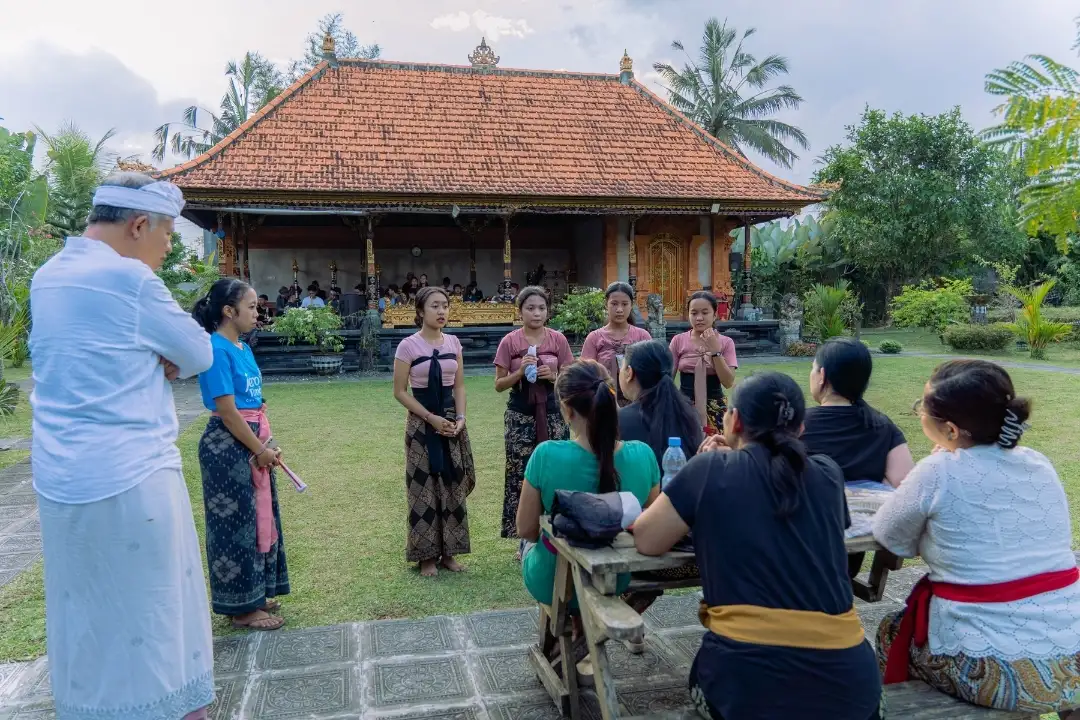
At Jero Tumbuk, local mentors, staff, cultural practitioners, and community members can become part of the guest experience. A simple conversation can introduce you to details about Balinese life that you would probably not discover by moving quickly between tourist attractions.
You might ask a local mentor about a traditional practice. You might learn why a particular ingredient is used in cooking. You might hear about how cultural knowledge is taught to children. You might discover something about farming or village life simply because you had enough time to ask a question.
These interactions do not have to be formal. In fact, some of the most valuable conversations happen naturally. They may begin with a simple question and continue because you have time to listen.
This human connection is an important part of cultural immersion Karangasem. You are not simply looking at the destination from the outside. You are creating opportunities to understand it through the people who live there.
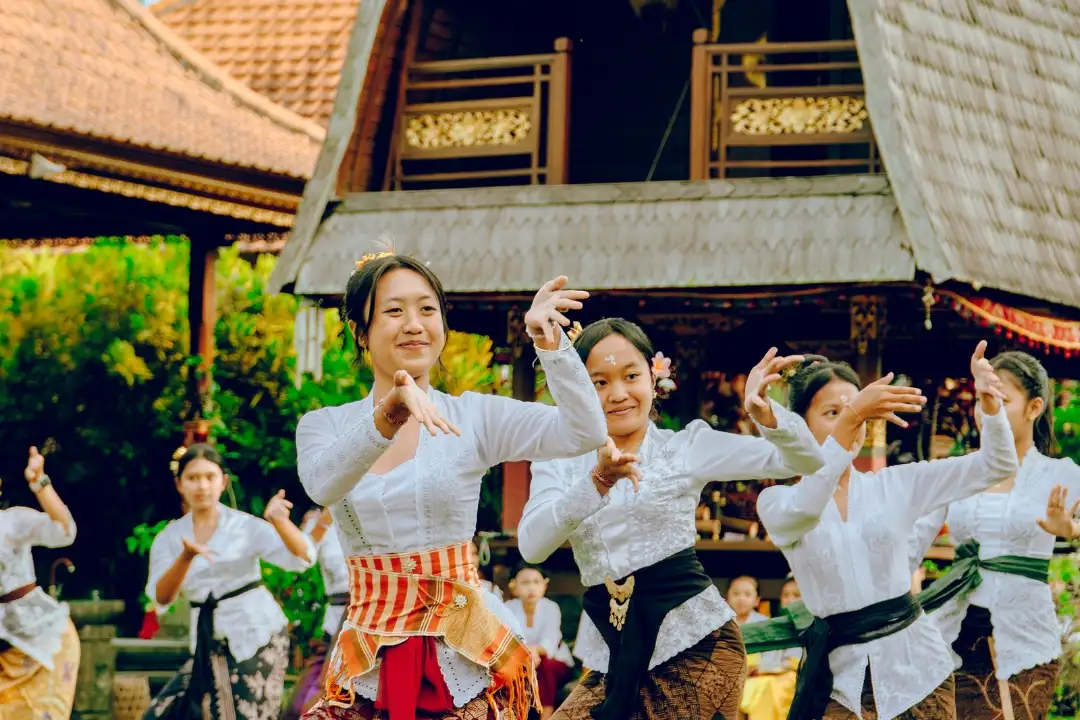
One of the clearest differences between fast and slow travel is the opportunity to participate. A busy itinerary often leaves room for cultural experiences only as something to observe. You watch a performance, photograph a traditional building, or visit a cultural attraction before moving on. A slower stay gives you the possibility of learning.
At Jero Tumbuk, cultural programs can introduce guests to practices such as Balinese dance, Tabuh, Gender, Rindik, Mekidung, Balinese script, and traditional cooking. These activities are not simply about creating something interesting for visitors to watch. They provide opportunities to learn directly from local mentors.
That distinction matters. When you try a traditional dance movement yourself, you begin to understand the practice behind the performance. When you learn a few elements of Balinese script, you gain a different perspective on cultural heritage. When you prepare a traditional dish, you begin to understand the relationship between ingredients, preparation, and food culture.
You do not need to master any of these activities during a short stay. The value is in the process of learning and in understanding that cultural traditions remain alive because people continue to practice and teach them. A slower itinerary gives you enough mental space to listen to the person guiding you rather than immediately thinking about where you need to go next.
One of the benefits of slowing down is that ordinary things can become more interesting. A rice field may not look like a major tourist attraction, but spending time walking through it can teach you about agriculture, seasonal farming, the daily work of farmers, and the relationship between food and the land.
The same applies to food. Instead of treating meals as something that happens between activities, you can use them as an opportunity to understand local life. A traditional cooking class can introduce you to local ingredients, Balinese spices, preparation techniques, and the cultural meaning of food.
This is where a nature retreat and cultural experience can naturally overlap. The rice fields are connected with agriculture. Agriculture is connected with food. Food is connected with community. Community is connected with the people who grow, prepare, teach, and share that knowledge.
When you move quickly, these connections can be easy to miss. When you slow down, they become easier to notice. This does not mean every meal or walk needs to become an educational activity. Sometimes, simply sitting down and enjoying food after learning how it was prepared is enough.
The point is to give yourself the opportunity to notice where your experience comes from.
Rest is often treated as the empty space between activities. On a slow trip, it becomes part of the experience itself. After a cultural class, you can take time to sit outside. After a rice field walk, you can return to your accommodation and rest. After a conversation with a local mentor, you can simply think about what you have learned.
These quiet periods can be surprisingly valuable because travel creates a lot of information. New places, unfamiliar traditions, different food, new people, and changing surroundings all require attention. Without time to pause, it can become difficult to absorb any of it.
A meaningful retreat Bali experience therefore does not need to be filled from morning until evening. Having an open afternoon can be just as important as having an activity planned.
Jero Tumbuk's environment allows guests to experience this slower rhythm while remaining connected with culture and nature. There is space to participate, but there is also space to stop. That balance can help you become more aware of your surroundings.
You may notice the sound of nature around the accommodation. You may spend longer looking at the landscape. You may have a conversation that would not have happened if you were already rushing toward the next destination. Slow travel creates room for these moments.
Bali's spiritual traditions require another kind of attention. A spiritual activity such as Melukat should not be approached as another item to check off a tourist itinerary. It has cultural and spiritual meaning, and visitors need to follow appropriate guidance when participating. Slowing down helps create the right mindset.
Instead of arriving with a camera ready and immediately thinking about the next activity, you have time to understand what you are participating in. You can listen to the person guiding the experience, understand the appropriate preparation, follow local instructions, and respect sacred spaces.
This is part of responsible travel in Bali. The goal is not to promise an instant spiritual transformation or treat a ritual as entertainment. It is to approach the experience with curiosity and respect.
The same principle applies to other cultural practices. You do not need to understand everything before arriving, but you should be willing to listen and learn. Giving an experience enough time is one of the simplest ways to demonstrate that respect.
Some travelers worry that slowing down means they will miss too much. In reality, it can mean choosing what is worth your attention.
Instead of visiting ten places and remembering only a few photographs, you might visit fewer places and remember the people you met, the food you prepared, the landscape you walked through, or the cultural practice you learned. You may return home with fewer destinations checked off your list, but with a stronger understanding of where you have been.
That is particularly valuable for travelers interested in responsible travel Bali. Responsible travel is not only about avoiding environmental damage or respecting local rules. It can also involve giving yourself enough time to understand the communities and cultures you are visiting rather than treating them as attractions to consume quickly.
A slower journey can encourage more thoughtful participation.
Bali does not have to be experienced as a race between attractions. You can choose fewer destinations and spend more time in each place. You can talk with local people rather than simply photographing the surroundings. You can join a cultural class instead of only watching a performance. You can walk through rice fields and learn about agriculture. You can enjoy local food with more awareness of where it comes from. You can approach spiritual activities with respect. And you can leave enough time to rest and observe.
These choices may sound simple, but together they can change the character of a trip. At Jero Tumbuk, the idea of slowing down fits naturally with the wider purpose of a cultural retreat. Accommodation is only one part of the experience. Culture, nature, spirituality, education, and community are all connected within the environment.
That means you do not have to choose between a relaxing holiday and a culturally meaningful one. You can have both.
Perhaps the most valuable part of slowing down is realizing that Bali does not always need to give you another attraction. Sometimes, it gives you a landscape to walk through, a person to talk to, a traditional skill to learn, a meal to share, or simply a quiet moment to notice where you are.
That is what can make slow travel Bali more than a different way of planning a holiday. It can become a different way of understanding the place you came to experience.