5 Things That Make a Jero Tumbuk Trip Easy to Remember
Home - Our Journal

Home - Our Journal
Some travel memories come from spectacular places. Others stay with you because of something much simpler. You remember the person who taught you something new, the meal you prepared together, a conversation with someone from the local community, or the feeling of sitting quietly surrounded by nature.
These moments can be easy to overlook when a Bali holiday is built around moving quickly from one attraction to another. A photograph may capture where you were, but it does not always capture what you learned or how you felt while experiencing the place.
A memorable Bali experience can come from participation rather than sightseeing alone. When you become involved in an activity, meet local people, learn about traditions, or spend enough time in one environment to notice its details, the experience can become more personal.
This is part of what makes a Jero Tumbuk retreat different. Located in Selat, Karangasem, Jero Tumbuk brings together culture, nature, spirituality, education, community, and accommodation within one wider experience. The stay is not simply about having somewhere to sleep. It creates opportunities to learn, participate, and understand a different side of Bali.
If you are looking for an authentic Bali holiday, these are five kinds of moments that may stay with you long after you leave.

There is something memorable about being a beginner. When you travel, you are often surrounded by things you have never seen before, but simply looking at something does not necessarily mean you understand it. Learning a new skill changes that relationship because you become part of the process.
At Jero Tumbuk, guests may have opportunities to learn through cultural activities such as Balinese dance, traditional music, Balinese script, Mekidung, or cooking, depending on the programs available during their stay. These experiences introduce visitors to practices that are connected with local knowledge and community life.
The value is not in becoming an expert during one session. You might struggle to remember a dance movement, need several attempts to produce the right sound from an instrument, or discover that preparing traditional food requires more steps than you expected. Those small difficulties can actually make the experience more memorable.
You remember trying something for the first time. You remember the person guiding you. You remember the moment when a technique finally started to make sense.
A local mentor can also provide context that you would not get from simply watching a performance. They can explain a technique, correct your approach, answer questions, and help you understand why the practice matters.
For travelers, this creates a more active form of cultural learning. You are not simply collecting photographs of Bali. You are taking home a small piece of knowledge that you experienced directly. That is often the kind of memory that stays longer than a checklist of destinations.
Spiritual experiences can become some of the most meaningful parts of a Bali trip, but they also require a different approach from ordinary tourism. Melukat, for example, is a sacred Balinese purification ritual and should not be treated as an entertainment activity or marketed as an instant solution to personal problems. Its meaning is connected with Balinese spirituality and cultural practice, which means visitors need to approach it with respect.
If guests have the opportunity to participate in Melukat at Jero Tumbuk, preparation and local guidance are important. Appropriate clothing, respectful behaviour, and following the instructions of the people guiding the ritual all form part of the experience.
Photography should also never take priority over the ritual itself. Guests should ask before taking photographs and respect any areas or moments where documentation is not appropriate.
This can create a very different kind of spiritual experience Bali. Instead of focusing on what can be photographed or shared afterward, the attention remains on understanding the cultural context and participating respectfully.
The memory may not be a dramatic one. It might be the quietness of the setting, the explanation given before the ritual, the feeling of paying attention to something unfamiliar, or the realization that not every travel experience is meant to be consumed quickly.
That is part of the value. You are not simply visiting a cultural practice. You are being given an opportunity to approach it with awareness.
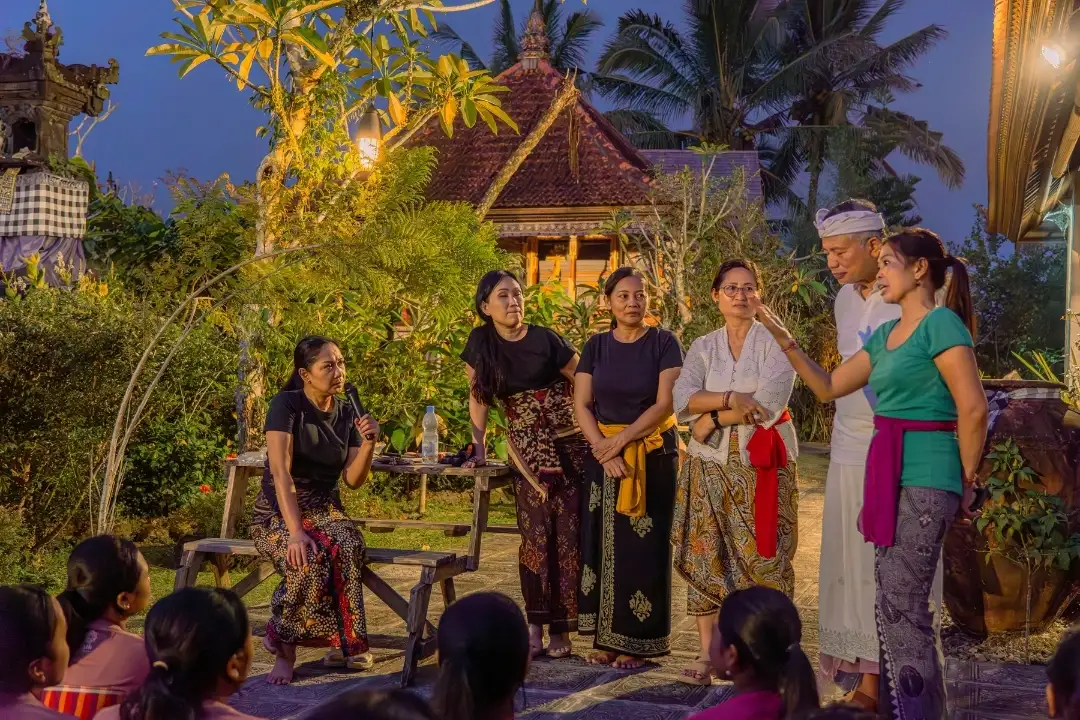
A destination becomes more personal when you begin to know something about the people who live there. A beautiful landscape can give you an impression of Bali, but a conversation can give you context. You may learn about a traditional practice from a cultural mentor, hear about farming while walking through rice fields, or discover something about local food from someone preparing a meal.
At Jero Tumbuk, local staff, cultural mentors, farmers, teachers, and other community members can all be part of the wider environment surrounding the guest experience. These interactions do not have to be formal.
A simple conversation during a cultural class can lead to a question about local traditions. A cooking activity can lead to a discussion about ingredients. A walk through the village landscape can give you an opportunity to understand more about agriculture and everyday life.
This is what makes a local community experience different from simply visiting a tourist attraction. You are not looking at a community from the outside. You are spending time in an environment where people live, work, teach, practice traditions, and maintain relationships with the surrounding land.
It is also important to approach these interactions respectfully. Local people are not attractions, and their stories should not be treated as something visitors are automatically entitled to. Listening, asking appropriate questions, and respecting personal boundaries are all part of responsible travel.
Sometimes, the conversation you remember most from a trip is not the one you planned. It is the one that happened naturally because you had enough time to stop and talk.
Food is one of the easiest ways to bring people together because everyone can participate in some way. A traditional cooking experience at Jero Tumbuk allows guests to become involved in the process rather than simply arriving at a table when the food is already prepared. You can learn about ingredients, prepare spices, follow traditional methods, and work together with the people guiding the activity.
The process itself can become the memory. Perhaps one person is preparing the ingredients while another is trying to follow the recipe. Someone makes a small mistake and everyone laughs. A local facilitator explains why a particular spice is prepared in a certain way. Eventually, everyone sits down and shares the meal they helped create.
These moments can feel more personal than simply ordering a traditional dish from a restaurant. The food becomes connected with the people and the experience behind it.
This is also why a cooking activity can work well for different types of travelers. Couples can prepare something together, families can involve different generations, and solo travelers can use the experience as an opportunity to meet a local facilitator and learn through conversation.
The important part is not whether the final dish looks perfect. It is that you were involved. When you return home, you may not remember every ingredient perfectly, but you are more likely to remember the process, the people around you, and the feeling of sitting down to eat something you helped prepare.
That is the kind of detail that can turn food into a lasting travel memory.

Some memories are created simply by slowing down enough to notice where you are. Jero Tumbuk includes traditional spaces such as the Angkul-Angkul, Bale Ageng, Merajan, Jineng, Beji, Wantilan, and Puwaregan. These are not simply decorative elements placed around an accommodation. They have different functions and meanings within Balinese life.
The Angkul-Angkul, for example, represents a traditional entrance and a transition into the space beyond it. Bale Ageng relates to gathering and community. Merajan is a sacred space connected with spirituality and family worship. Jineng reflects the relationship with agriculture and food storage, while Beji is connected with purification.
Understanding these spaces can change the way you look at traditional architecture. Instead of seeing a building simply as something visually attractive, you begin to ask why it was built, how it was used, and what role it continues to have.
Guests should also remember that not every traditional or sacred space is simply an area for exploration. Some places require appropriate behaviour and respect. Follow local guidance, ask before entering restricted areas, and avoid treating sacred spaces as photo locations.
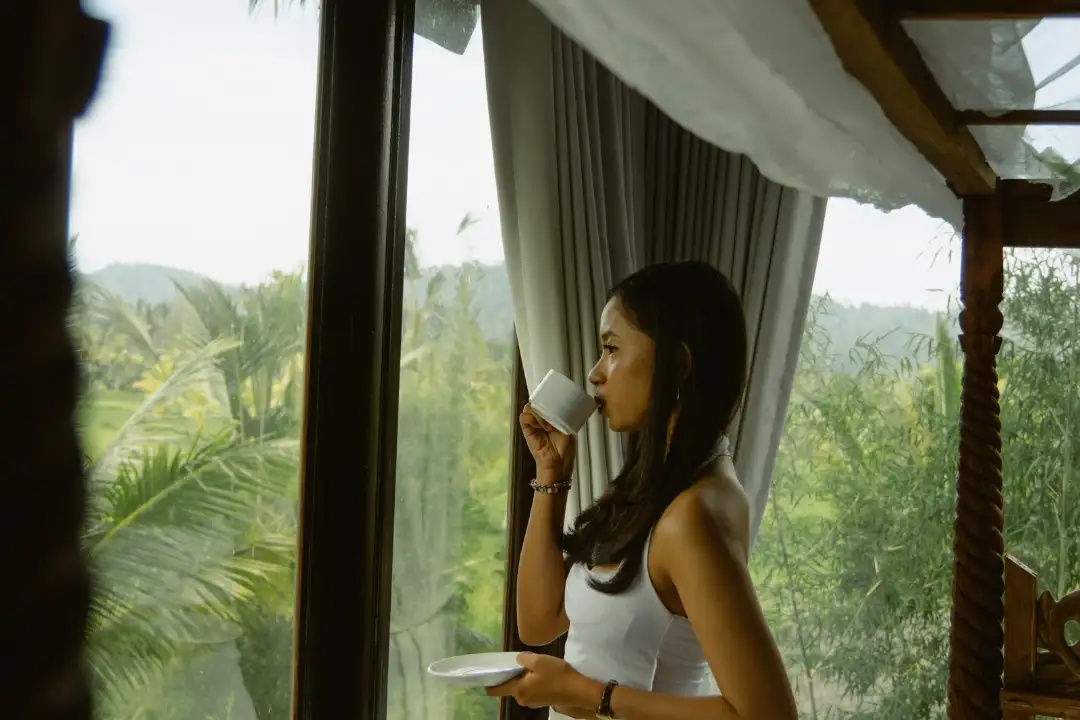
The surrounding natural environment adds another layer to the experience. You can walk through rice fields, spend time among greenery, listen to the river, read outdoors, or simply sit and observe the landscape. The experience does not have to involve an adventurous activity. Sometimes the most memorable part is simply having enough time to notice the environment.
This is where a nature retreat Karangasem experience connects naturally with culture. The landscape, architecture, agriculture, spirituality, and community are not isolated elements. They exist alongside one another.
When people think about memorable holidays, they often remember the obvious highlights. A spectacular view, a famous attraction, or an unusual activity can easily become the headline of a trip. But travel memories are often built from smaller details.
You remember the sound of the river while sitting outside. You remember the person who patiently taught you a traditional technique. You remember preparing food with someone you had only just met. You remember walking through the rice fields and finally understanding that the landscape is connected to people's daily work. You remember entering a traditional space and learning why it matters.
These moments may not look extraordinary from the outside, but they can become meaningful because you were present for them. That is why a meaningful travel Bali experience does not necessarily require more activities. It may simply require more attention to the activities you choose.

One of the biggest advantages of staying at a cultural retreat is having the opportunity to experience something without immediately moving on to the next destination. After a cooking class, you can take your time with the meal. After learning from a cultural mentor, you can spend the afternoon reflecting on what you learned. After walking through the rice fields, you can return to the retreat and enjoy the natural surroundings.
There is no need to fill every empty space. The time between activities can become part of the memory too. This is particularly relevant at Jero Tumbuk because the experience is built around a slower relationship with culture, nature, community, and spirituality. Guests can participate without turning the entire stay into a tightly scheduled itinerary.
The goal is not to leave with the longest list of activities. It is to leave with experiences you actually remember.
An authentic Bali holiday does not have to be defined by how many attractions you visit. It can be defined by how closely you pay attention to the experiences you choose.
At Jero Tumbuk, that might mean learning a traditional skill from a local mentor, approaching Melukat with respect, having an unexpected conversation with someone from the community, preparing a meal together, understanding the meaning behind traditional spaces, or spending a quiet afternoon surrounded by nature.
These experiences connect with the wider philosophy behind Jero Tumbuk. Culture is practiced rather than simply displayed. Nature is part of everyday life. Community is part of the guest experience. Spirituality is approached with respect. Learning happens through participation.
That is what makes the memories feel different. You are not simply taking something home in the form of photographs. You are taking home something you learned, something you understood, someone you met, or a moment you experienced more slowly than you normally would. And sometimes, those are the memories that remain long after the holiday itself is over.